[1]:
# Remove input cells at runtime (nbsphinx)
import IPython.core.display as d
d.display_html('<script>jQuery(function() {if (jQuery("body.notebook_app").length == 0) { jQuery(".input_area").toggle(); jQuery(".prompt").toggle();}});</script>', raw=True)
Direction recontruction (DL2)
WARNING
This is still a work-in-progress, it will evolve with the pipeline comparisons and converge with ctaplot+cta-benchmarks.
Author(s):
Dr. Michele Peresano (CEA-Saclay/IRFU/DAp/LEPCHE), 2020
based on previous work by J. Lefacheur.
Description:
This notebook contains benchmarks for the protopipe pipeline regarding the angular distribution of the showers selected for DL3 data.
NOTES:
a more general set of benchmarks is being defined in cta-benchmarks/ctaplot,
follow this document by adding new benchmarks or proposing new ones.
Requirements:
To run this notebook you will need a set of DL2 data produced on the grid with protopipe. The MC production to be used and the appropriate set of files to use for this notebook can be found here.
The data format required to run the notebook is the current one used by protopipe . Later on it will be the same as in ctapipe + pyirf.
Development and testing:
TODO:
add missing benchmarks from CTA-MARS comparison
crosscheck with EventDisplay
Table of contents
[2]:
%matplotlib inline
import matplotlib.pyplot as plt
cmap = dict()
import matplotlib.colors as colors
from matplotlib.colors import LogNorm, PowerNorm
count = 0
for key in colors.cnames:
    if 'dark' in key:
    #if key in key:
        cmap[count] = key
        count = count + 1
#cmap = {'black': 0, 'red': 1, 'blue': 2, 'green': 3}
cmap = {0: 'black', 1: 'red', 2: 'blue', 3: 'green'}
import os
from pathlib import Path
import numpy as np
import pandas as pd

import astropy.coordinates as c
import astropy.wcs as wcs
import astropy.units as u
import matplotlib.pyplot as plt
[3]:
def compute_psf(data, ebins, radius):
    nbin = len(ebins) - 1
    psf = np.zeros(nbin)
    psf_err = np.zeros(nbin)
    for idx in range(nbin):
        emin = ebins[idx]
        emax = ebins[idx+1]
        sel = data.loc[(data['true_energy'] >= emin) & (data['true_energy'] < emax), ['xi']]
        if len(sel) != 0:
            psf[idx] = np.percentile(sel['xi'], radius)
            psf_err[idx] = psf[idx] / np.sqrt(len(sel))
        else:
            psf[idx] = 0.
            psf_err[idx] = 0.
    return psf, psf_err

def plot_psf(ax, x, y, err, **kwargs):
    color = kwargs.get('color', 'red')
    label = kwargs.get('label', '')
    xlabel = kwargs.get('xlabel', '')
    xlim = kwargs.get('xlim', None)

    ax.errorbar(x, y, yerr=err, fmt='o', label=label, color=color) #, yerr=err, fmt='o') #, color=color, label=label)
    ax.set_ylabel('PSF (68% containment)')
    ax.set_xlabel('True energy [TeV]')
    if xlim is not None:
        ax.set_xlim(xlim)
    return ax
[4]:
# First we check if a _plots_ folder exists already.
# If not, we create it.
Path("./plots").mkdir(parents=True, exist_ok=True)
[5]:
# EDIT ONLY THIS CELL WITH YOUR LOCAL SETUP INFORMATION
parentDir = "" # full path location to 'shared_folder'
analysisName = ""
[6]:
indir = os.path.join(parentDir, "shared_folder/analyses", analysisName, "data/DL2")
infile = 'DL2_tail_gamma_merged.h5'
data_evt = pd.read_hdf(os.path.join(indir, infile), "/reco_events")
good_events = data_evt[(data_evt["is_valid"]==True) & (data_evt["NTels_reco"] >= 2) & (data_evt["gammaness"] >= 0.75)]
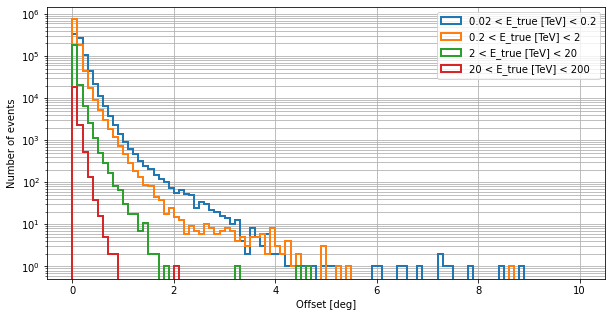
Here we use events with the following cuts: - valid reconstructed events - at least 2 reconstructed images, regardless of the camera - gammaness > 0.75 (mostly a conservative choice)
Energy-dependent offset distribution
[7]:
min_true_energy = [0.02, 0.2, 2, 20]
max_true_energy = [0.2, 2, 20, 200]

plt.figure(figsize=(10,5))
plt.xlabel("Offset [deg]")
plt.ylabel("Number of events")

for low_E, high_E in zip(min_true_energy, max_true_energy):

    selected_events = good_events[(good_events["true_energy"]>low_E) & (good_events["true_energy"]<high_E)]

    plt.hist(selected_events["offset"],
             bins=100,
             range = [0,10],
             label=f"{low_E} < E_true [TeV] < {high_E}",
             histtype="step",
             linewidth=2)

plt.yscale("log")
plt.legend(loc="best")
plt.grid(which="both")

plt.savefig(f"./plots/DL3_offsets_{analysisName}.png")

plt.show()
Angular resolution
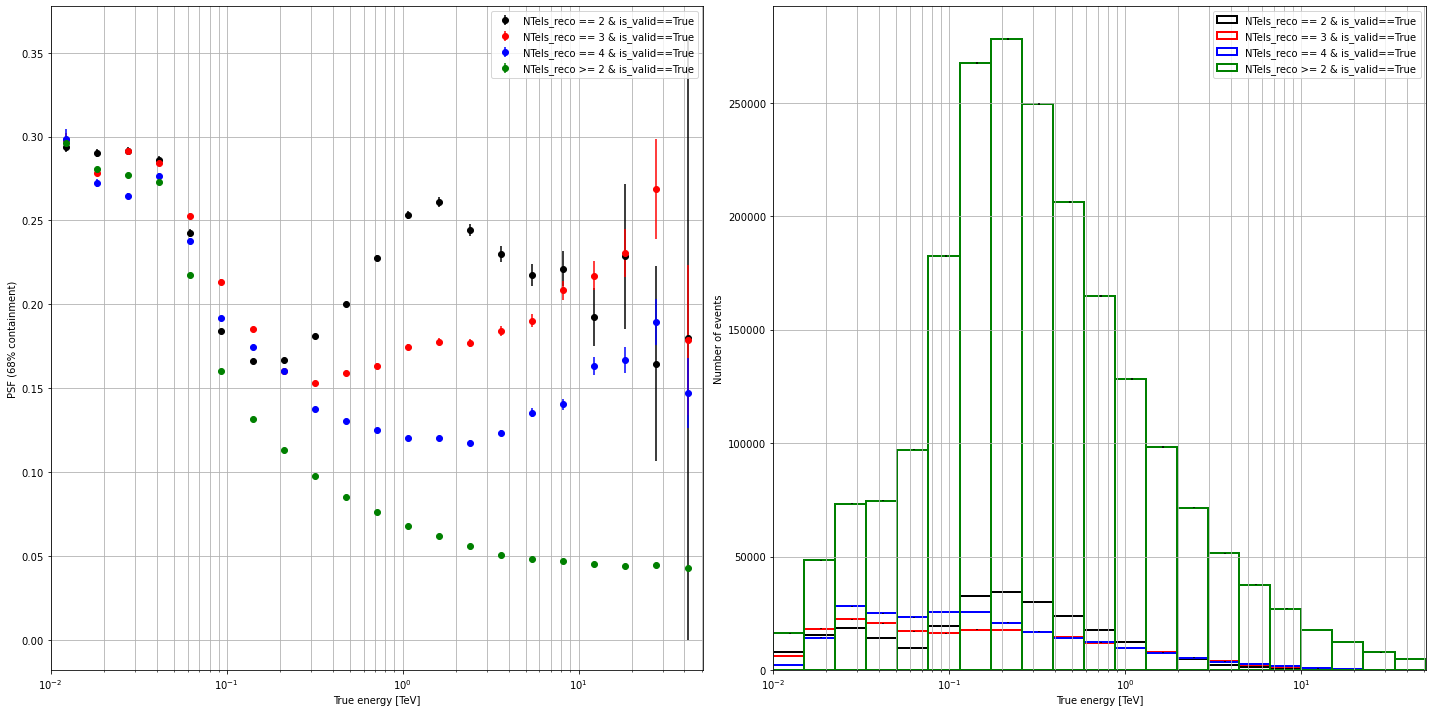
Here we compare how the multiplicity influences the performance of reconstructed events.
[8]:
r_containment = 68

energy_bins = 21
max_energy_TeV = 0.0125
min_energy_TeV = 200.0
energy_edges = np.logspace(np.log10(0.01), np.log10(51), energy_bins + 1, True)
energy = np.sqrt(energy_edges[1:] * energy_edges[:-1])
multiplicity_cuts = ['NTels_reco == 2 & is_valid==True',
                     'NTels_reco == 3 & is_valid==True',
                     'NTels_reco == 4 & is_valid==True',
                     'NTels_reco >= 2 & is_valid==True']

events_selected_multiplicity = [good_events[(good_events["NTels_reco"]==2)],
                                good_events[(good_events["NTels_reco"]==3)],
                                good_events[(good_events["NTels_reco"]==4)],
                                good_events[(good_events["NTels_reco"]>=2)]]

fig, axes = plt.subplots(nrows=1, ncols=2, figsize=(20, 10))
axes = axes.flatten()

cmap = {0: 'black', 1: 'red', 2: 'blue', 3: 'green'}

limit = [0.01, 51]
for cut_idx, cut in enumerate(multiplicity_cuts):
    #data_mult = data_evt.query(cut)
    data_mult = events_selected_multiplicity[cut_idx]
    psf, err_psf = compute_psf(data_mult, energy_edges, 68)
    opt={'color': cmap[cut_idx], 'label': multiplicity_cuts[cut_idx]}
    plot_psf(axes[0], energy, psf, err_psf, **opt)

    y, tmp = np.histogram(data_mult['true_energy'], bins=energy_edges)
    weights = np.ones_like(y)
    #weights = weights / float(np.sum(y))
    yerr = np.sqrt(y) * weights
    centers = 0.5 * (energy_edges[1:] + energy_edges[:-1])
    width = energy_edges[1:] - energy_edges[:-1]
    axes[1].bar(centers, y * weights, width=width, yerr=yerr, **{'edgecolor': cmap[cut_idx], 'label': multiplicity_cuts[cut_idx], 'lw': 2, 'fill': False})
    axes[1].set_ylabel('Number of events')

for ax in axes:
    ax.set_xlim(limit)
    ax.set_xscale('log')
    ax.legend(loc='best')
    ax.grid(which='both')
    ax.set_xlabel('True energy [TeV]')

plt.tight_layout()

fig.savefig(f"./plots/DL3_PSF_{analysisName}.png")
PSF asymmetry
[9]:
reco_alt = good_events.reco_alt
reco_az = good_events.reco_az

# right now all reco_az for a 180° deg simualtion turn out to be all around -180°
#if ~np.count_nonzero(np.sign(reco_az) + 1):
reco_az = np.abs(reco_az)

# this is needed for projecting the angle onto the sky
reco_az_corr = reco_az * np.cos(np.deg2rad(good_events.reco_alt))

true_alt = good_events.iloc[0].true_alt
true_az = good_events.iloc[0].true_az

daz = reco_az - true_az
daz_corr = daz * np.cos(np.deg2rad(reco_alt))
dalt = reco_alt - true_alt

plt.figure(figsize=(5, 5))

plt.xlabel("Mis-recontruction [deg]")
plt.ylabel("Number of events")

plt.hist(daz_corr, bins=100, alpha=0.5, label = "azimuth")
plt.hist(dalt, bins=100, alpha=0.5, label = "altitude")

plt.legend()
plt.yscale("log")
plt.grid()

print("Mean and STDs of sky-projected mis-reconstruction axes")
print('daz = {:.4f} +/- {:.4f} deg'.format(daz_corr.mean(), daz_corr.std()))
print('dalt = {:.4f} +/- {:.4f} deg'.format(dalt.mean(), dalt.std()))

plt.show()
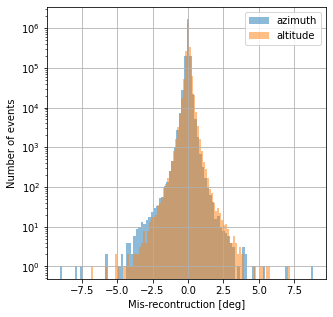
Mean and STDs of sky-projected mis-reconstruction axes
daz = -0.0070 +/- 0.1190 deg
dalt = 0.0003 +/- 0.1429 deg
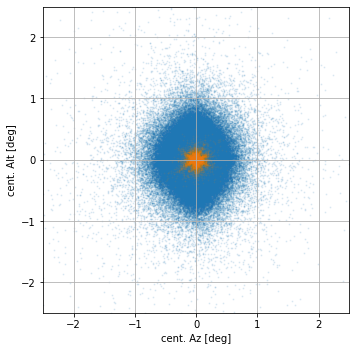
2D representation with orange events being those with offset < 1 deg and E_true > 20 TeV
[10]:
angcut = (good_events['offset'] < 1) & (good_events['true_energy'] > 20)

plt.figure(figsize=(5,5))
ax = plt.gca()
FOV_size = 2.5 # deg

ax.scatter(daz_corr, dalt, alpha=0.1, s=1, label='no angular cut')
ax.scatter(daz_corr[angcut], dalt[angcut], alpha=0.05, s=1, label='offset < 1 deg & E_true > 20 TeV')

ax.set_aspect('equal')
ax.set_xlabel('cent. Az [deg]')
ax.set_ylabel('cent. Alt [deg]')
ax.set_xlim(-FOV_size,FOV_size)
ax.set_ylim(-FOV_size,FOV_size)
plt.tight_layout()
plt.grid(which="both")

fig.savefig(f"./plots/PSFasymmetry_2D_altaz_{analysisName}.png")
True energy distributions
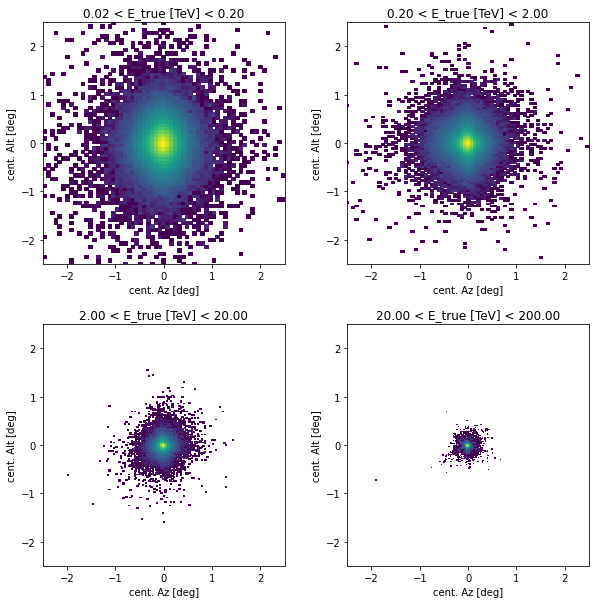
[11]:
plt.figure(figsize=(10,10))
plt.subplots_adjust(hspace=0.25)
true_energy_bin_edges = np.logspace(np.log10(0.02), np.log10(200), 5)
nbins = 200

for i in range(len(true_energy_bin_edges)-1):

    plt.subplot(2, 2, i+1)

    mask = (good_events["true_energy"]>true_energy_bin_edges[i]) & (good_events["true_energy"]<true_energy_bin_edges[i+1])

    plt.hist2d(daz_corr[mask], dalt[mask], bins=[nbins,nbins], norm=LogNorm())
    plt.gca().set_aspect('equal')
    #plt.colorbar()
    plt.xlim(-FOV_size, FOV_size)
    plt.ylim(-FOV_size, FOV_size)
    plt.title(f"{true_energy_bin_edges[i]:.2f} < E_true [TeV] < {true_energy_bin_edges[i+1]:.2f}")
    plt.xlabel('cent. Az [deg]')
    plt.ylabel('cent. Alt [deg]')
[ ]: